
3DPRINTING, PROJECTS5 MIN
SwitchVyper
SwitchVyper
An Anycubic Vyper converted into a Voron Switchwire-style 3D printer. The aluminium frame and the power supply of the Vyper stay. Everything else is rebuilt: printed frame parts, a chamber, linear rails and a Voron Stealthburner toolhead. The whole machine runs on Klipper.
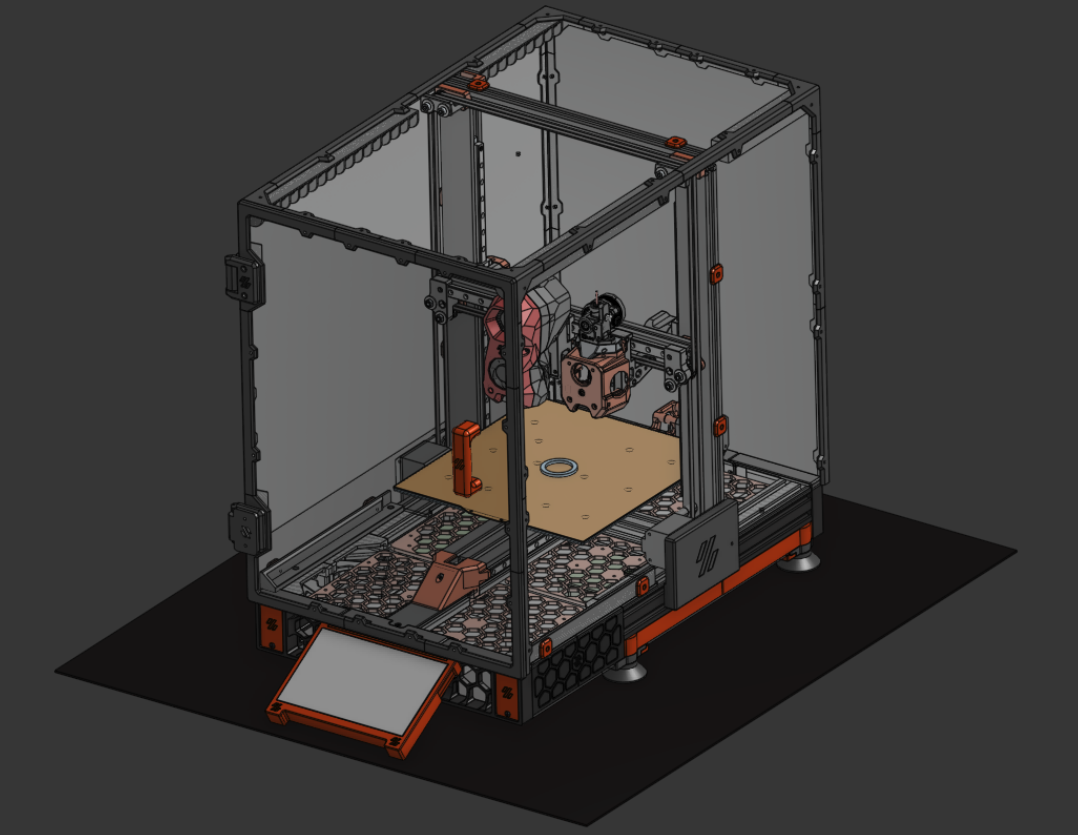
- GitHub: fabse-hack/SwitchVyper
- CAD model: Onshape
- Complete assembly as STEP: in the GitHub repository (
SwitchVyper.step)
Why the conversion?
The Vyper comes with a solid aluminium frame and a power supply that are still worth using. The Switchwire concept (CoreXZ, bed moving in Y) is compact and well documented, and a chamber is part of the design from the start. Instead of building a whole new printer, I reuse the parts I already have.
What stays, what is new?
Reused from the Anycubic Vyper
- Original aluminium frame
- Power supply (120 W)
- Some end stops
Added or replaced
- Printed frame parts and chamber
- Linear rails
- Voron Stealthburner toolhead
- Mainboard, stepper drivers and Raspberry Pi (see below)
Hardware
Control
| Component | Details |
|---|---|
| Host | Raspberry Pi 4B+, 4 GB RAM |
| Mainboard | BIGTREETECH SKRat V1.0 |
| Stepper drivers | TMC2209 V1.3 |
| Toolhead board | EBB36 (CAN bus) |
| Software | Klipper, Moonraker, Mainsail |
Toolhead
- Voron Stealthburner
- Trianglelab BMG extruder kit
- Phaetus Dragon Standard Flow hotend (45.6 mm)
- Klicky probe, without microswitch
- XY PCB and cable
- GDSTime fans
- Harness for a 350 mm Voron 2.4 with Frombot kit cables
CAD model
The complete model lives in Onshape and is split into these assemblies:
- Ground frame
- Printed frame
- Electronics
- Y axis
- XZ axis
- Chamber
Electronics and standard hardware are modeled in basic detail only. The model also includes two imported toolhead options:
- Voron Stealthburner with PCB, without stepper motor
- A4T toolhead with Orbiter 2.5 and Rapido UHF 2.0
Configuration and notes
- Slicer: In OrcaSlicer, part cooling is configured under Filament > Cooling.
- Retraction: Firmware retraction is enabled in
printer.cfg. - Calibrating extrusion: Check
rotation_distancefirst when you calibrate extrusion and flow. It directly changes the amount of filament that gets extruded. - CAN bus: Since 20 June 2026 the toolhead is connected through an EBB36 on the CAN bus. Instead of many single wires, the toolhead communicates over one cable.
Build log
4 November 2024 Documented the starting point: controller, network setup and toolhead build with Stealthburner, extruder, hotend, probe, PCB and fans.
18 December 2025 Installed TMC2209 V1.3 drivers and the BIGTREETECH SKRat V1.0 mainboard.
28 December 2025 Rough cost estimate for the toolhead and CAN bus upgrade:
| Part | Price |
|---|---|
| EBB36 Gen 1 | about €15 |
| U2C | about €15 |
| 2x 4010 fans | about €15–20 |
| 1x 2510 fan | about €10 |
| X1C hotend | about €15 |
| LEDs, cables, small parts | about €10 |
| Umbilical cable | about €10 |
These are historical estimates, not a current shopping list.
9 January 2026 Set up part cooling in OrcaSlicer.
20 June 2026 Converted the printer to CAN bus with an EBB36 and adjusted the macros.
4 July 2026
Updated calibration and macros, enabled firmware retraction. Noticed that rotation_distance affects extrusion and flow calibration.
1 September 2026 Replaced the CW2 latch after it broke and stopped gripping the filament correctly.
Files
Besides the STEP model, the repository contains the latch files (latch.stl, Latch_fat_finger.stl, latch.step) and the manuals for the SKRat mainboard.
To do
- [ ] Multi-material support with EMU
- [ ] Toolhead cutter
- [ ] Try toolheads optimized for TPU and other materials
- [ ] Passive heatsink for the Raspberry Pi, if needed
- [ ] Connect the 24 V filter fans